
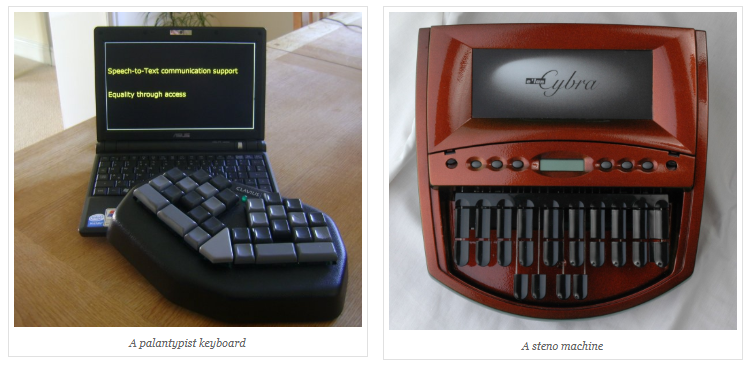
Stenographer, palantypist, and transcriptionist – what’s the difference?
When you think of a stenographer, you probably picture someone sitting in a courtroom, frantically typing out everything that’s being said, but this is just a simplified version we see on TV.
In reality, it’s more complicated than that, and once people start using words like typist, palantypist, and transcriptionist, then things really start to get confusing.
Speech-to-text reporter
A speech-to-text reporter, or STTR for short, is someone who can take what is being said live and transcribe it through a machine to be read by deaf or hard-of-hearing people, either immediately or at a later date.
Speech-to-text reporters normally have extensive training, usually two years of training with another couple of years of practice. This allows STTRs to build up their skills, becoming faster and more accurate.
A stenographer, palantypists, and transcriptionists are all forms of speech-to-text, but they vary in different ways.
Stenographers and Palantypists
A stenographer and a Palantypist do the same thing but in slightly different ways; the only difference is the machine they use.
A stenograph machine is an American invention, which is probably why you’ve heard of it, while a Palantype is the British version (Palantype is actually a trademark).
Both machines are very similar, but each has its own slight advantages over the other.
The biggest advantage of a stenograph is its popularity. There are many places you can find if you want to learn how to use a stenograph, but the Palantype is hardly taught now and machines are becoming less and less popular.
Speed-wise they are both the same under skilled and experienced fingers, but for simplicity, the stenograph has fewer keys – but that means the Palantype has few conflicts and is easier to learn.
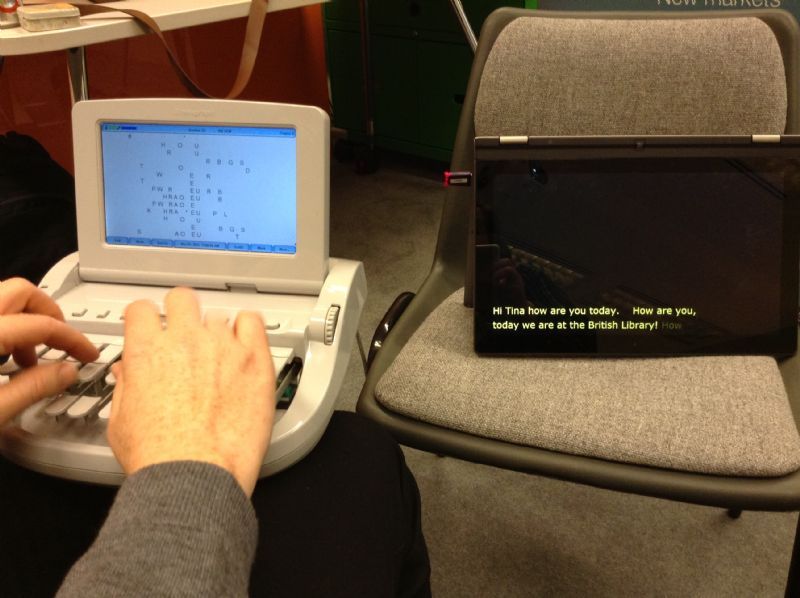
Both machines use electronic shorthand keyboard software which is linked to a computer. The computer then converts the shorthand into their proper words.
Using either of these machines is not like typing on a regular keyboard. Keys can be pressed at the same time to give different words, and typically they are both at least twice as fast as a standard QWERTY keyboard, with some experienced STTRs writing up to 360 words per minute.
While STTRs are typically associated with courtrooms, they can be used in a variety of situations, such as live captioning and academic settings.
Transcriptionists and typists
Transcriptionists and typists are often used synonymously, but again, there are differences.
A transcriptionist listens to recorded files and converts what they hear into text. They can be used in the medical, legal, and general transcription industries. The difference between a transcriptionist and an STTR is usually a transcriptionist does their work after the fact rather than live.
A typist can produce typed documents with speed and accuracy, usually somewhere around 70 words per minute using a standard QWERTY keyboard. The difference between a transcriptionist and a typist is, a typist will often have other duties included within the role, such as filing, photocopying, answering phones, and other administrative tasks.
Whatever help you need, call us
Whether it’s live captioning, court transcribing, or subtitles after the fact, contact 121 Captions today and let’s have a chat about what you need and how we can help.
Our writers have over 20 years of international experience, can write in over 16 languages, and they can understand deaf voices, so they are able to write what everybody says.
Our STTRs can be anywhere in the world, all we need is a microphone and an internet connection!








Trackbacks & Pingbacks
[…] who train in writing using specialist shorthand machines can write over an astonishing 300 words per minute – just as fast as someone talking – with […]
Leave a Reply
Want to join the discussion?Feel free to contribute!